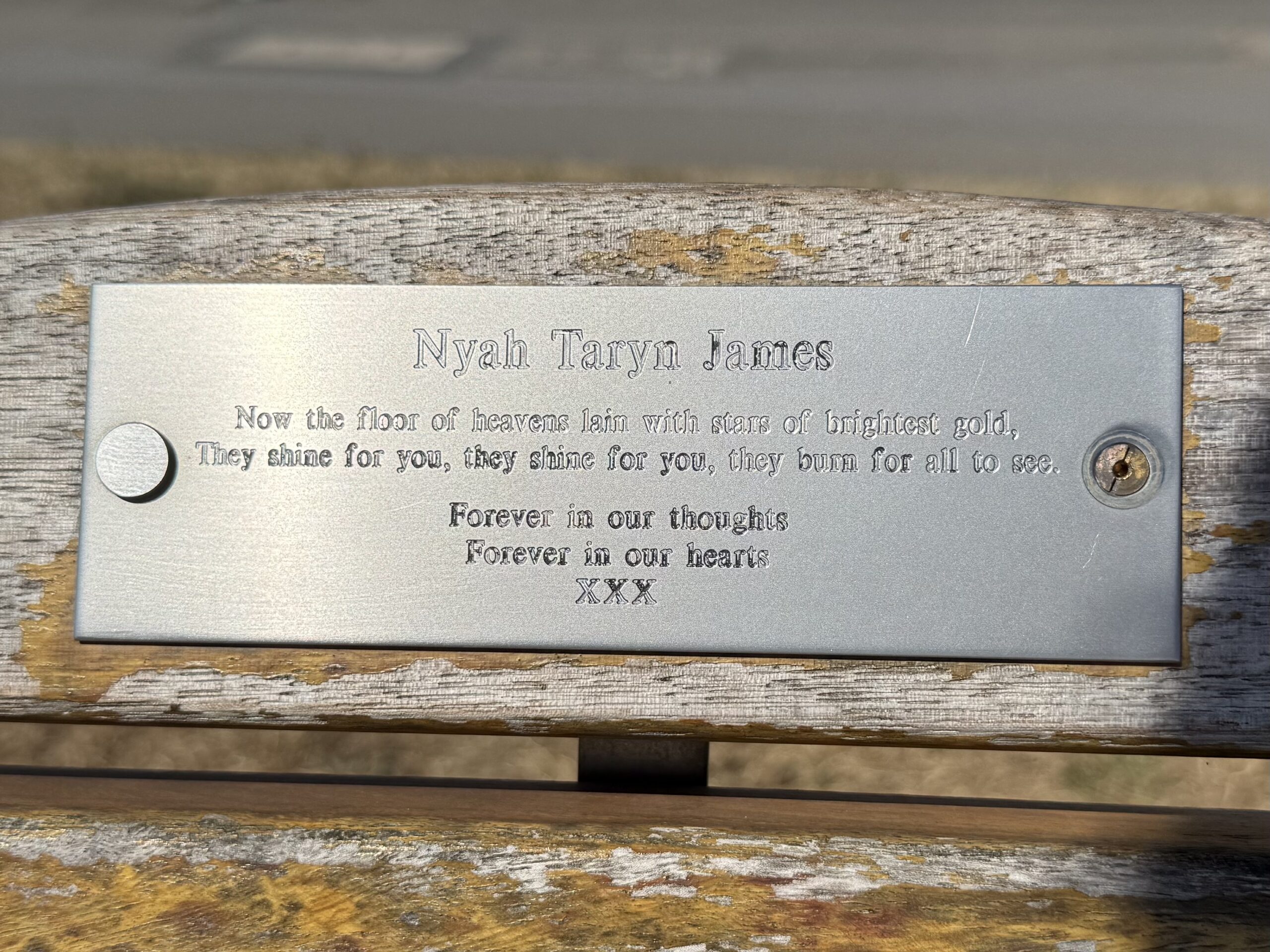
Just randomly dawned on me that I haven’t met anyone called Imogen in many years.
Are any of you out there?
Do you still exist?
Just randomly dawned on me that I haven’t met anyone called Imogen in many years.
Are any of you out there?
Do you still exist?
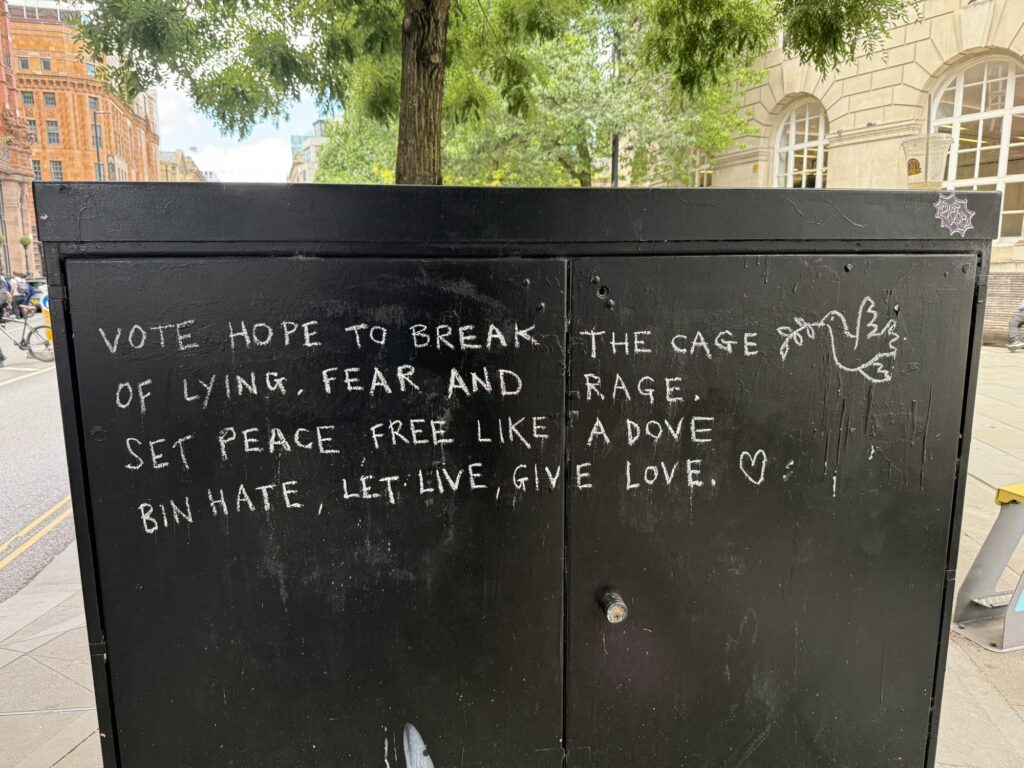
Putting aside the political angle, which I try to stay relatively neutral on whilst writing here, this graffiti in Manchester city centre provides a remarkably solid foundation for living life more generally.

As Andy Marsh, CEO of the College of Policing, said recently about the media’s trust in policing:
“Trust arrives on a tortoise and it leaves on a horse.”
I’ll be thinking about that as I serve customers at my day job today.
For knowledge-based questions, it seems logical to assume that you’re more likely to ask an AI tool about things that you don’t know much—if anything—about than things you do.
That inherently means that you’re less likely to know whether what it’s telling you is correct or not, or how to check. We’ll call it the Altman Paradox.
Check your facts, kids.
I was on a Northern Rail train recently and did what every autistic train nerd does best. That’s right—I became the first human in recorded history to read the safety poster.
My only question is “Why On Earth Is It Written In Pascal Case?”.

Just stopped at a train station and used the toilet but the toilet paper was worse than the schools of the 1960s and 1970s… It should be a legal requirement that any toilet roll in public places must be a minimum of two-ply, if not more.

Back when I was a fresh-faced 16 year old, I was in a long-distance relationship (if I can call it that, given the benefit of a decade of hindsight!) with a girl called Hanna all the way from the United States of America. She was my first love, my first heartbreak, and my first real taste of the Yanks.
When things went sour, as teenage relationships so often do, and I couldn’t as much as face getting out of bed for two days straight, she told me that, if I were ever sad and she couldn’t be there to soothe my stinging heart, she hoped that I’d listen to Drops of Jupiter by Train and think of her.
After wading my way through a very turbulent decade for such a day to come, I became fortunate enough a year ago tonight to stand just metres from Pat Monahan, and to blast my heart out to one of the songs that stands out to me as one of the few reasons that I held on when I felt like I had no other reason to do so.
So, Hanna, if you ever end up back in the atmosphere, with Drops of Jupiter in your hair, and happen to stumble on this piece, I want simply to say thank you. What we had was a fleeting moment in amongst a rather hectic lifetime, but it happened, it mattered, and it’s remembered through its ripples on my life to this day.

Just seen this little guy on my commute and managed to stand still long enough to photograph him. Cute, ain’t he?
I watched a documentary on BBC iPlayer a few days ago, which felt poignant after the death of Mr Hockney earlier this month.
Being a big fan of bright and bold colours, I’ve always been particularly fond of his painting of Nichols Canyon in Los Angeles.

A rather remarkable man, by all accounts, with a talent that was clear to see. What a loss.
As my Now page will tell you, my day job is handling complaints for a major UK-based telecommunications company. My role sits in our executive complaints team, where we deal with the most serious of complaints—those sent to our senior bosses, to MPs, to the papers, and so on.
One of the most fascinating parts of my job is the edge cases.
Think about it: our frontline customer service operation is optimised for the 99% of queries that come in at scale:
What comes to my team is the remaining 1%—the edge cases.
When you speak to a dozen ordinary people every day, you have the privilege of seeing beneath the tip of the iceberg. What might be simply the third complaint about our home phone service that day for me might be quite literally the difference between life and death for a vulnerable customer with a telecare alarm connected.
It’s the same with other types of complaint too. A complaint about bills being too high might sit atop recent redundancy. A complaint about a missed engineer’s appointment might be because the customer struggles with their mobility and couldn’t get to the door in time. A complaint about the wrong name on a letter might come just days or weeks after a bereavement.
As anyone who has ever worked in customer service will tell you, it’s seldom the case that anyone contacts you on the best day of their life. Indeed, my best days have been spent with my nearest and dearest, a varied playlist on Apple Music, and a creamy pint of Guinness, rather than sat alone calling my broadband provider.
By the time that you’re wound up enough to escalate all the way to my team, your complaint is often less about how it started and more about the journey that you’ve had along the way. At that point, it’s often gone from a simple enquiry to feeling like you’re being heard but not listened to. My first job is to remind you that there’s a human just like you behind the brand.
It makes me think that we need to look at complaints differently: not just as a measure of when we get things wrong, but as a mirror of the complex and interconnected lives that we all now lead. I struggle to think of many complaints that I’ve dealt with lately that have been as simple as a service failure alone.
As I sign off, I shall leave you with one of my favourite quotes by the late MP Jo Cox, as I think it sums up far more elegantly than I ever could what my job reminds me of every day:
“We all have far more in common than that which divides us.”
Jo Cox MP
The more customers that I speak to, the more I think about just how right she was.